
Call us now :07313725950
 Send Inquiry
 Send Inquiry
Sintered Metallurgical Parts
Sintered Metallurgical Parts Specification
- Feature
- High strength, Wear resistance, Corrosion resistance, Precise tolerances
- Product Type
- Sintered Metallurgical Parts
- Material
- Iron, Bronze, Stainless Steel (Customizable)
- Shape
- Customized / As per drawing
- Chemical Composition
- Fe, Cu, Zn, C, Ni (as per requirement)
- Purity
- Up to 99%
- Weight
- 2 g 500 g (customizable)
- Dimension (L*W*H)
- Customized, typically 10 mm 200 mm range
- Density
- 7.5 Gram per cubic centimeter(g/cm3)
- Grade
- Standard, High Precision, Custom Grades
- Application
- Other
- Color
- Gray/Bronze/Metallic
Sintered Metallurgical Parts About
Sintered Metallurgical Parts
Owing to our wide experience in the metal sheets domain, our company is counted among the foremost exporters and importers of Sintered Metallurgical Parts. We have maintained amiable relations with our vendors, so that we can offer extensive range of metallurgical parts to our clients. These parts are generally used to give flow and compacting characteristics, whilst ensuring excellent mechanical strength, self lubrication and grade or porosity for oil retention in their finished form. Our Sintered Metallurgical Parts are well appreciated in the market for their excellent quality and longer shelf life.
Further Details:
Sequence of production:
Forming ( or compacting ), Sintering, Sizimg, Oil Impergnation
Materials : Sintered bronze / Iron sintered ad per IS : 3980 : 1982
Range : Plain & Flanged Bushes, Self aligned Bushes, Solid Rod, Plate & different profile components as per drawings / samples.
Application : Sintered Beonze Bushes are used for high Speed application ( upto 18000 rpm ) Iron Sintered bushed are for speed ( upto 3000 rpm ).
Materials Composition:
|
Grade I, Copper Base |
||||
|
Elements |
Class A % |
B3% |
B2 % |
B1% |
|
Iron ( Fe ) |
1.00 mAX |
48-50 |
38-40 |
28-30 |
|
Tin ( Sn) |
8-9.5 |
4-6 |
4-6 |
4-6 |
|
Carbon ( C ) |
2.0 mAX. |
2.0 |
2.0 |
2.0 |
|
Impurities |
2.0 |
2.0 |
2.0 |
2.0 |
|
Copper ( Cu ) |
BAL |
BAL |
BAL |
BAL |
|
Grade II, Iron Base |
||||
|
Elements |
CLASS A % |
B3 % |
B2 % |
B1% |
|
Copper ( Cu ) |
1.00 Max |
9-11 |
4-6 |
1.5-3.5 |
|
Carbon ( C) |
0.25 Max |
0.25 |
0.25 |
0.25 |
|
Impurities |
2.0 |
2.0 |
2.0 |
2.0 |
|
Iron( Fe ) |
BAL. |
BAL. |
BAL. |
BAL. |
Advanced Manufacturing Through Powder Metallurgy
Our sintered metallurgical parts are created with advanced powder metallurgy techniques, enabling exceptional control over material properties. This process involves compressing powdered metals into a desired shape and sintering them at high temperatures. The result is high-density components with consistent quality, tailored porosity, and superior mechanical characteristics, all manufactured according to precise customer drawings and standards.
Precision Engineering for Multiple Industries
With the ability to meet tight tolerances and customizable features, these parts find use in automotive, machinery, and electrical sectors. Customization options include size (typically 10200 mm), shape, chemical composition, and grade. Their high strength, wear and corrosion resistance make them ideal for demanding environments, supporting various industrial and technical requirements with outstanding reliability.
FAQs of Sintered Metallurgical Parts:
Q: How are sintered metallurgical parts manufactured using the powder metallurgy process?
A: Powder metallurgy involves compacting carefully blended metal powders in a mold, followed by sintering at elevated temperatures. This process fuses the particles without melting them, achieving precise density, porosity, and mechanical properties as required for each application.Q: What industry sectors commonly use sintered metallurgical parts?
A: These components are widely utilized in automotive, industrial machinery, electrical, and various equipment sectors due to their precise tolerances, high strength, and reliable performance under challenging operating conditions.Q: When is a customized composition or geometry recommended for these parts?
A: Custom compositions or shapes are ideal when standard components do not meet performance, fit, or regulatory requirements. This allows for optimization in terms of strength, corrosion resistance, or unique design specifications based on customer needs or drawings.Q: Where do you provide packaging and delivery for sintered parts, and what are the available options?
A: Packaging and delivery are available throughout India and internationally. Parts can be packed in carton boxes, wooden cases, or custom packaging, ensuring they reach the customer safely and in pristine condition.Q: What benefits do sintered metallurgical parts offer over traditionally machined ones?
A: Sintered parts deliver excellent dimensional accuracy, material utilization, and allow for controlled porosity and complex shapes. They offer superior properties like wear resistance and high strength, reducing material waste and secondary machining requirements.Q: How adaptable are these parts to secondary machining or finishing processes?
A: These parts exhibit good machinability, enabling secondary operations such as drilling, reaming, or surface finishing if required, thus allowing for additional customization post-sintering to meet specific functional needs.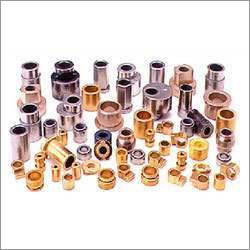
Tell us about your requirement

Price:
Quantity
Select Unit
- 50
- 100
- 200
- 250
- 500
- 1000+
Additional detail
Mobile number
Email

More Products in Sintered Metal Bearings Category
Sintered Porous Metal Bearings
Application : Other, Electric Motors, Fans, Domestic Appliances, Automotive, Pumps, Machinery
Purity : 99%
Grade : SAE 841 / ISO 4385
Chemical Composition : Copper 89%, Tin 11% (Bronze) or Iron 91%, Carbon 1%, Graphite 2%
Shape : CustomizedOother, Cylindrical (Bush Type and Flanged Type Available)
Product Type : Other, Sintered Porous Metal Bearings

 Send Inquiry
Our Products
- Metal Powder
- Nickel Based Products
- Tungsten Sheets
- Titanium Sheets & Plates
- Inconel Products
- Monel Alloy Products
- Electric Circuit Breaker
- Vacuum Circuit Breaker
- Load Break Switch
- Load Break Switch Panel
- Off Load Isolator
- Aluminium Copper Bimetal
- Nickel Silver Strips
- Beryllium Copper Strips
- Silver Brazing Alloy Products
- Silver Bearing Copper Commutator Segments
- Metals Sheets, Pipes & Rods
- Copper products
- Hot Rolled Copper
- Molybdenum Rods & Sheets
- Alloy Products
- Sintered Metal Bearings
- Industrial Virgin Metals
- Electrical Terminals
- Silver Copper Bimetal Rivets
- Electric Control Panel Accessories
- Brass Cable Glands
- Electrolytic Grade Wirebars
- L.T Control Switches
- Heavy Duty On Load Changeover Switches
- Hastelloy Products
- Vacuum Contactor
- Unitized Substation
- Low Voltage Electrical Panels
- Vacuum Circuit Breaker Panel
- Ring Main Unit (RMU)


No. - 12, Bhavani Bhuvan, 2nd Floor, 18/20 Popatwadi, Kalbadevi Road,Mumbai - 400002, Maharashtra, India

Mr. Dinesh
(Proprietor)
Mobile :07313725950
 Send Inquiry
 Send SMS
Developed and Managed by Infocom Network Private Limited.
